Stuck?  support@mecway.com

Mecway
FEA
Weird behaviour of material allocation

Hi all,
I have encountered weird behaviour of material allocation where I don't understand whats happening.
I have a three point bending model set up with two different components / materials.

The pads are soft linear elastig material to reduce stress concentration.
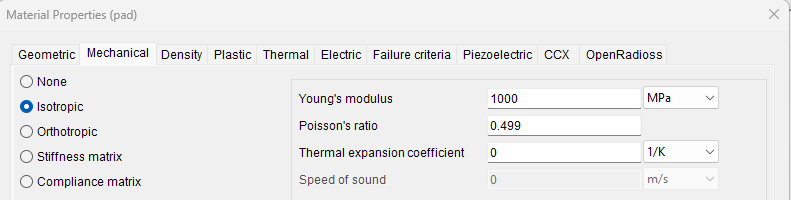
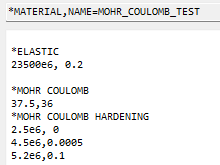
The beam is defined es Mohr Coulomb with Mohr Coulomb Hardening. Never mind the properties, they are arbitrary at this stage.
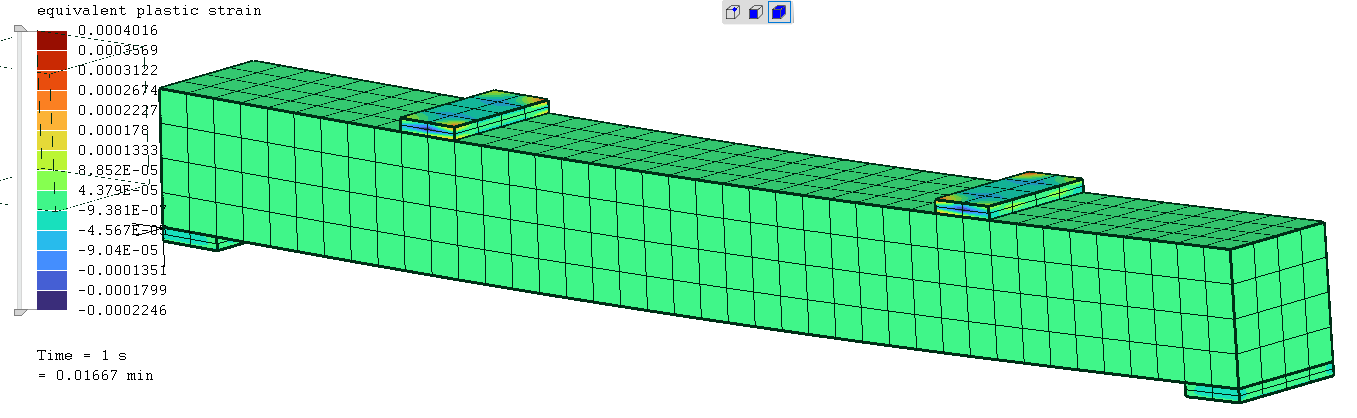
Now the strange bit: I would expect plastic strain to occur at the bottom of the beam, but that is not the case. Infact, plastic strain is zero in the entire bearm but instead there is some plastic strain in the pads (which are linear elastic).
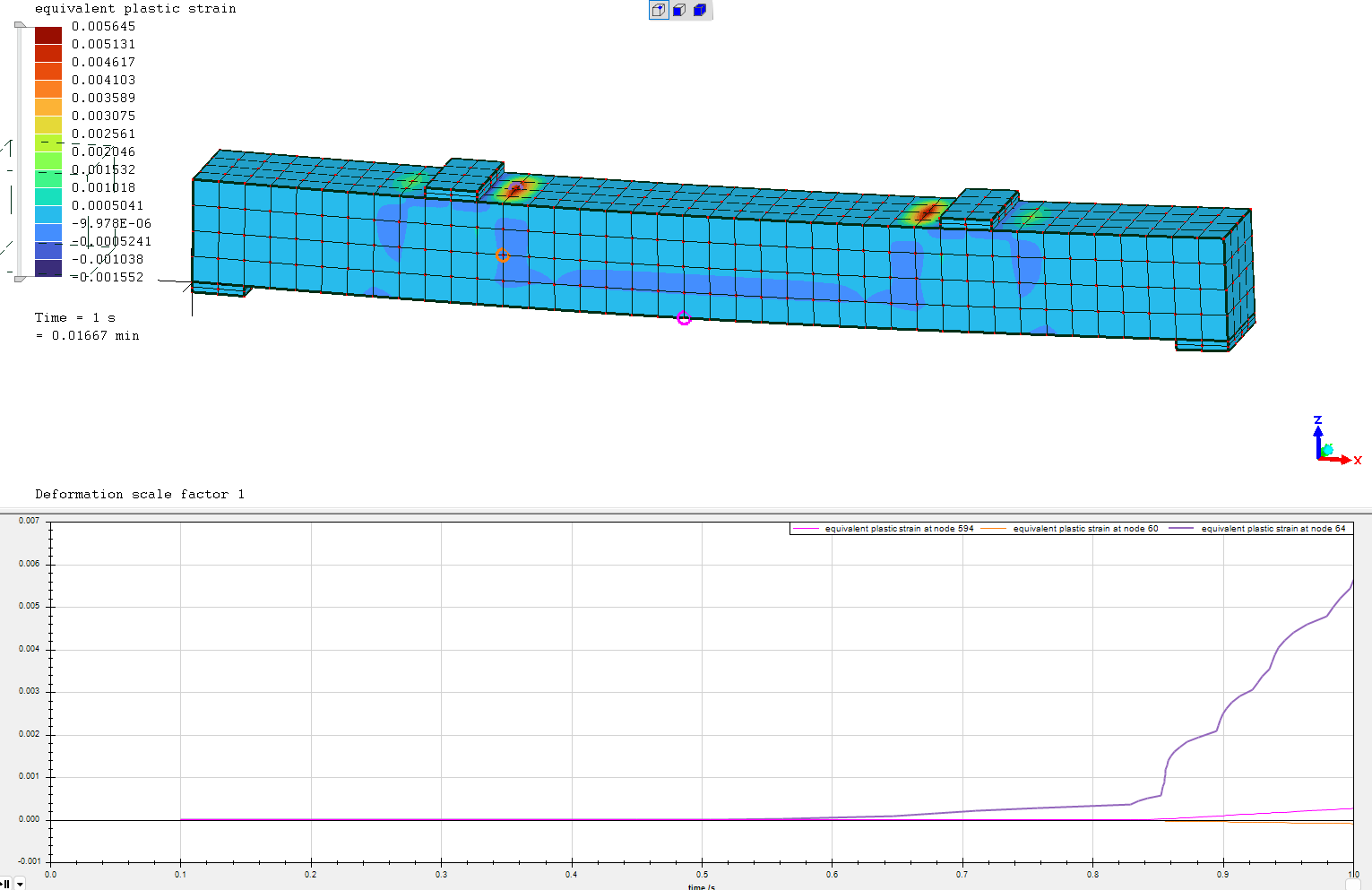
If I invert the material defintion, I get plastic strain in the beam but not in the pad.
The elastic properties (stiffness) is allocaded correctly, only the Mohr Coulomb part seems to be swapped.
If I allocate the pad material to both components, I get no plastic strain as expected.
If I allocate the Mohr Coulomb material to both components, I get plastic stain in the beam only. But that is due to the fact that the plasticity limit is not reached in the pads. I added a separete element with pad material to check.
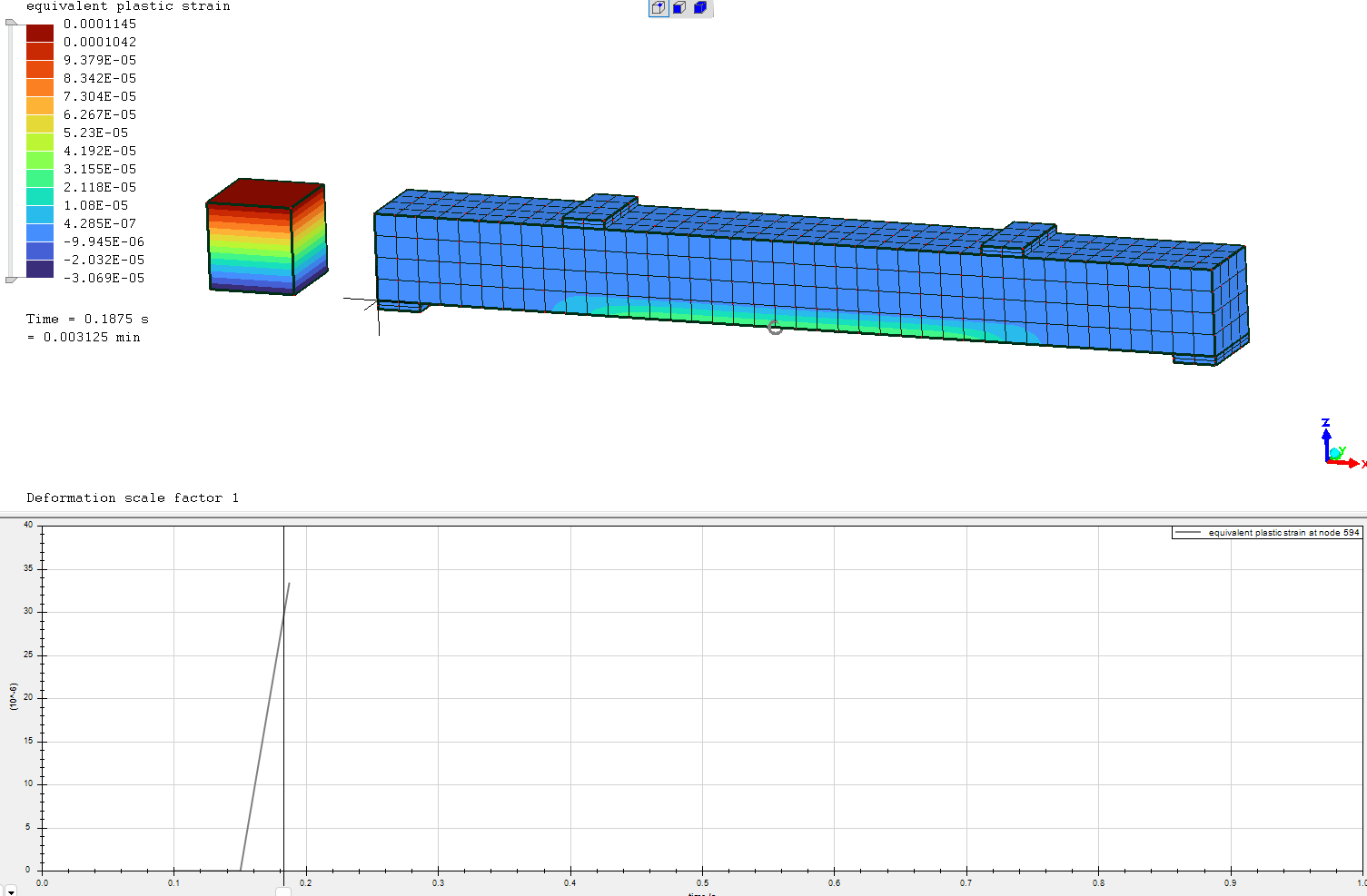
I attached my sample model.
Does anyone have an idea whats happening?
Thanks a lot!
I have encountered weird behaviour of material allocation where I don't understand whats happening.
I have a three point bending model set up with two different components / materials.
The pads are soft linear elastig material to reduce stress concentration.
The beam is defined es Mohr Coulomb with Mohr Coulomb Hardening. Never mind the properties, they are arbitrary at this stage.
Now the strange bit: I would expect plastic strain to occur at the bottom of the beam, but that is not the case. Infact, plastic strain is zero in the entire bearm but instead there is some plastic strain in the pads (which are linear elastic).
If I invert the material defintion, I get plastic strain in the beam but not in the pad.
The elastic properties (stiffness) is allocaded correctly, only the Mohr Coulomb part seems to be swapped.
If I allocate the pad material to both components, I get no plastic strain as expected.
If I allocate the Mohr Coulomb material to both components, I get plastic stain in the beam only. But that is due to the fact that the plasticity limit is not reached in the pads. I added a separete element with pad material to check.
I attached my sample model.
Does anyone have an idea whats happening?
Thanks a lot!
Howdy, Stranger!
It looks like you're new here. If you want to get involved, click one of these buttons!
Comments
thanks for the reply!
I had a look ath the model "Corrected Mohr Coulomb" that you provided.
When I apply the material ("Mohr_Coulomb_TEST(2)") that you created in the model, indeed I do get plastic strain in the beam.
However, if I copy and paste your material definition into the existing material inside my original model, I again have not plastic strain in the beam.
Looking at the Input file shows that the material defintions have swapped order in your model. Probably duplicating the material and reapplying it moved it to the end in the input file.
Stangely, it seems to me that the Mohr Coulomb Hardening is not applied to the right material defintion somehow...
I set up a model (attached) with 4 cubes to check. Only "A" has a Mohr Coulomb material. "B", "C", and "D" are linear elastic.
Appearently, the mohr plasticity is applied only to cube "D" for some reason.
Input file:
*MATERIAL,NAME=A_MOHR
*ELASTIC
23500e6, 0.2
*MOHR COULOMB
37.5,36
*MOHR COULOMB HARDENING
2.5e6, 0
4.5e6,0.0005
5.2e6,0.1
*MATERIAL,NAME=B
*ELASTIC,TYPE=ISOTROPIC
23500000000,0.2
*MATERIAL,NAME=C
*ELASTIC,TYPE=ISOTROPIC
23500000000,0.2
*MATERIAL,NAME=D
*ELASTIC,TYPE=ISOTROPIC
23500000000,0.2
Could it be for some reason that the mohr coulomb material is alway aplied to the last material definition in the input file? I'm confused...
With the above material definition plasticity starts at about 2MPa at a randomly selected node which is approximately what I would expect. So units should be ok, or am i missing someting?
I don't quite understand what you meant with the wrong supports. Can you explain?
Thanks for taking the time!