Stuck?  support@mecway.com
support@mecway.com

Mecway
FEA
Multibody parts connection

Hi,
The approach I published some days ago may have an interesting usage when applied multibody systems.
https://mecway.com/forum/discussion/1750/extend-only-compression-support#latest
If it is of general interest, it would require some changes internally in MECWAY compression only definition.
Actually, all the bases of the gapuni elements associated to compression only supports are grouped for later fixation.
That should be changed.
Instead of fixing each node base, they should be part of a rigid body definition with its corresponding Ref node so the user would be free to apply BC and loads to that REF Node.
Fixing the REF and ROT could be the default option to mimic the actual behavior.
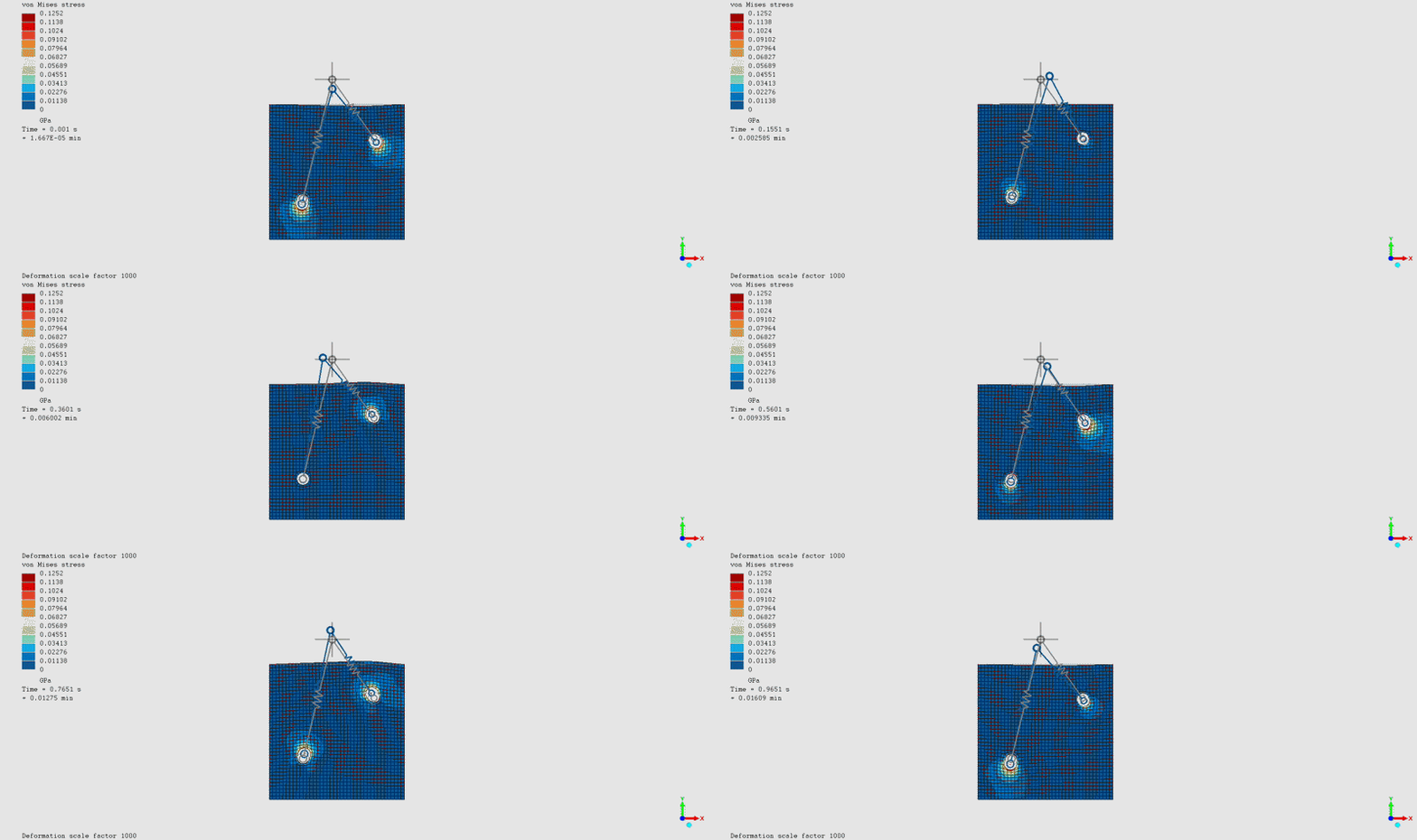
I have done some tests, and it works nicely. See Vid.
What does it mean in terms of improvement?. Loads transferred between different components of a multibody system by means of sleeves would only transfer load in the compressed contact area as they should.
Now, I don’t think there is a way to get that without introducing contacts (Pain) and detailed modeling of the sleeve.
Regards
The approach I published some days ago may have an interesting usage when applied multibody systems.
https://mecway.com/forum/discussion/1750/extend-only-compression-support#latest
If it is of general interest, it would require some changes internally in MECWAY compression only definition.
Actually, all the bases of the gapuni elements associated to compression only supports are grouped for later fixation.
That should be changed.
Instead of fixing each node base, they should be part of a rigid body definition with its corresponding Ref node so the user would be free to apply BC and loads to that REF Node.
Fixing the REF and ROT could be the default option to mimic the actual behavior.
I have done some tests, and it works nicely. See Vid.
What does it mean in terms of improvement?. Loads transferred between different components of a multibody system by means of sleeves would only transfer load in the compressed contact area as they should.
Now, I don’t think there is a way to get that without introducing contacts (Pain) and detailed modeling of the sleeve.
Regards
Howdy, Stranger!
It looks like you're new here. If you want to get involved, click one of these buttons!
Comments
This machine has three of this set ups and it converge nicely.
Principal Stress 1 (Tensle) and 3 (Red_Compressive).The piece is free to move .
Let's see if I can explain with my poor English. ChatGPT doesn't understand me.
An only compression support creates a set of elements in which the surface is supported. "Like" regular springs but nonlinear in this case. They only work when there is compression on them. If you take the base of all those new elements and create a Rigid body with them, you can move that supporting base.
*RIGID BODY,NSET=COMPRESSIONONLY,REF NODE=A,ROT NODE=B
You can apply loads, displacements and even rotations to that base through the ref and rot nodes. You can also link to different parts through the REF and ROT.
In a spider you cannot constrain their rotations because they don't have rotational degrees of freedom which is the source of some important limitations and convergence issues.
By other hand the spider meet at the center which becomes a singular point when talking about rotations.
Only compression computes the stiffness of each gapuni automatically to get a uniform pressure distribution. With a spider that only happens when the nodes in the hole are uniformly distributed unless you do it manually.
Look at the vid. In some way you can almost see the effect of the pin through the hole. I made the Compression only surface to rotate around two axes through the ROT node. One can almost see the pin rotating inside the hole. It is even pushing at the back side of the plate the same way it would do a real pin.
In my first vid the REF is linked to the spring via equation. In the second there are three of this set ups. The most complex is the one conecting the REF to a beam (handle) midside node . But thats another story.
Another drawback of the idea with spider gap elements would be, I think, that the element orientation of the gap elements does not change with their rotation. So if large rotations happen, it would probably lose accurary or fail.
So with your approach, if I understand correctly, we would basically get a mobile compression only support that can be constrained with regular bondary conditions or connected to another part?!
That sounds like a very nice addition to me!
The model is a one element cube. The top face is fixed. On the bottom face there is a compression only support. The compression only support creates new nodes (11, 12, 13, 14) and puts them into a node set "COMPRESSIONONLY". I manually use those nodes to define a riged body with two additonal nodes (9 and 10) as REF NODE and ROT Node.
*RIGID BODY,NSET=COMPRESSIONONLY ,REF NODE=9 ,ROT NODE=10
Additionally I omit the *BOUNDARY keyword and define custom definitions to manipulate the rod node.
Result is, the bottom of the cube is tilted around x and y axis by the rigid body that supports the compression only support.
please feel free to comment if anything is messed up...
** Generated by Mecway 32 *NODE 1,0,0,0 2,0.001,0,0 3,0.001,0.001,0 4,0,0.001,0 5,0,0,0.001 6,0.001,0,0.001 7,0.001,0.001,0.001 8,0,0.001,0.001 9,0.0005,0.0005,0 10,0.0005,0.0005,-0.0001 11,0,0,0 12,0,0.001,0 13,0.001,0.001,0 14,0.001,0,0 *ELEMENT,TYPE=C3D8I 1,8,5,1,4,7,6,2,3 *ELEMENT,TYPE=GAPUNI 2,1,11 3,4,12 4,3,13 5,2,14 *NSET,NSET=COMPRESSIONONLY 11 12 13 14 *ELSET,ELSET=DEFAULT 1 *ELSET,ELSET=COMPRESSIONONLY_1 2 *ELSET,ELSET=COMPRESSIONONLY_2 3 *ELSET,ELSET=COMPRESSIONONLY_3 4 *ELSET,ELSET=COMPRESSIONONLY_4 5 *SURFACE,NAME=COMPONLY 1,S5 *MATERIAL,NAME=ALUMINIUM *ELASTIC,TYPE=ISOTROPIC 70000000000,0.35 *DENSITY 2700 *SOLID SECTION,ELSET=DEFAULT,MATERIAL=ALUMINIUM *GAP,ELSET=COMPRESSIONONLY_1 0,0,0,-1,,2.5E+14,2.5E-10 *GAP,ELSET=COMPRESSIONONLY_2 0,0,0,-1,,2.5E+14,2.5E-10 *GAP,ELSET=COMPRESSIONONLY_3 0,0,0,-1,,2.5E+14,2.5E-10 *GAP,ELSET=COMPRESSIONONLY_4 0,0,0,-1,,2.5E+14,2.5E-10 *RIGID BODY,NSET=COMPRESSIONONLY ,REF NODE=9 ,ROT NODE=10 *BOUNDARY 5,1,,0 5,2,,0 5,3,,0 6,1,,0 6,2,,0 6,3,,0 7,1,,0 7,2,,0 7,3,,0 8,1,,0 8,2,,0 8,3,,0 *STEP,NLGEOM=YES,INC=100 *STATIC 1,1,1E-06,0 *NODE FILE,GLOBAL=YES U,RF *EL FILE S,NOE,E,ENER *BOUNDARY 9,1,,0 9,2,,0 9,3,,0 *BOUNDARY 10,1,,0.001 10,2,,0.001 *END STEPI guess you are looking for a hard contact behavior?.
Note there is only compression in the part of the base that is pushed up and compressed against the base. Node number 2 is left without support (tension) and reaction forces there becomes zero.
What would be the corresponding model where this kind of tilted base could be applied?.
I can imagine a pure displacement of the base downwards for example. To check the effects of a foundation partially failing or loosing stiffness.
Stiffness was still on a high value from playing around with it to get to know the impact.
Hi, I did not respond you just because I saw the Kuhl example file. Let me know if you need any further help. Regards.