Stuck?  support@mecway.com
support@mecway.com

Mecway
FEA
Extend Only Compression Support

I think it’s interesting to share this set up.
DCOUP 3D doesn’t behave as (Only compression) and the Only Compression support when it is applied to holes, it doesn’t allow the shortage of the piece so the loads on lugs are not correctly developed. It happens the same with Compression Only Support + Symmetry BC. It doesn’t behave as simply supported BC where moments are freely developed.
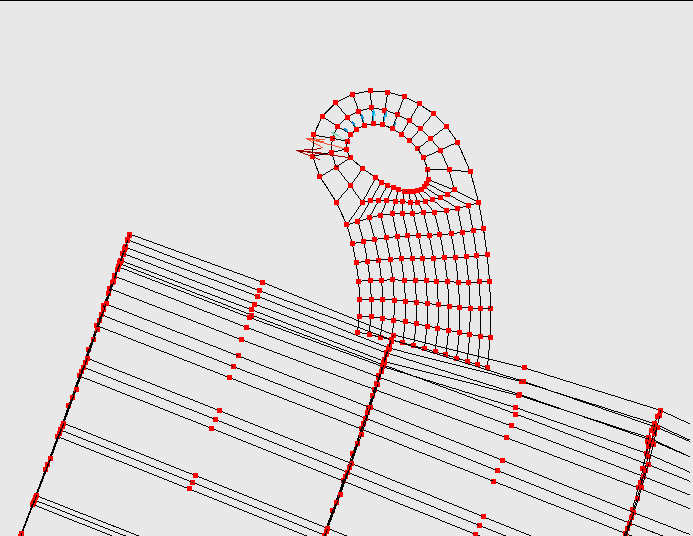
To solve it, I have managed to release one of the degrees of freedom of an Only compression Support. That allows me to simulate a rigging process without the need of fully modeling the shackle pin or Slings.
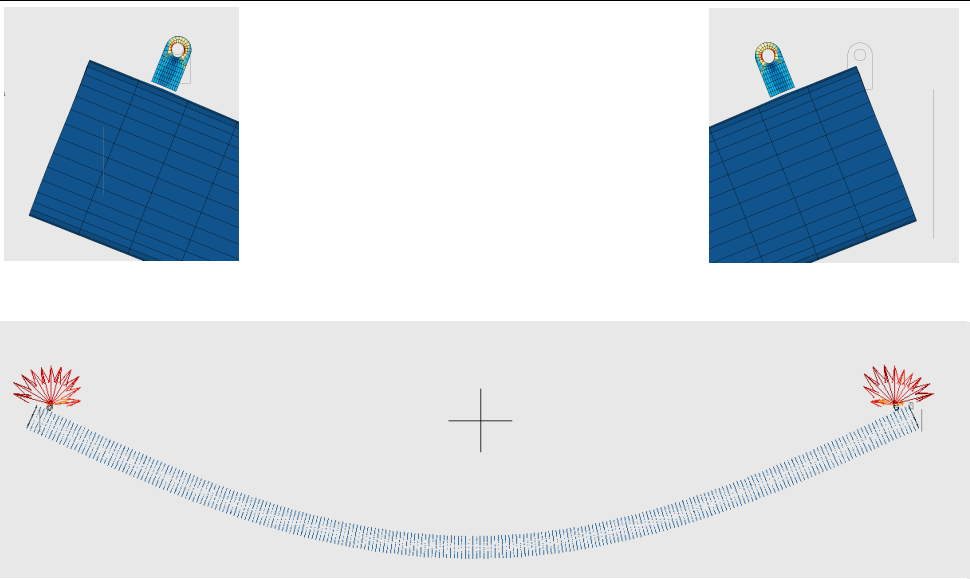
During the set-up process I have noticed two unexpected things:
1-Gravity load applied to the Only Compression area mess the convergence. (I have finally excluded it)
2-Solver keeps asking for density, but my gravity load is not applied to the GAP Elements.
*WARNING in calinput: no density was assigned
to material GAP in a dynamic
calculation or a calculation with
centrifugal or gravitational loads
or an incompressible CFD calculation
3- I still need to constrain the model transversely. ¿Why?. Seems to me that the constrain needs to be duplicated. I mean, why do I need to constrain the Base node of the Gapuni and the opposite node connecting to the model?.
Isn’t Gapuni acting in transverse directions?.
*BOUNDARY
COMPRESSIONONLY,1,,0
COMPRESSIONONLY(2),1,,0
N_Compression_1,1,,0
N_Compression_2,1,,0
Only Compression Support additional options:
In the same way I’m releasing ONE DOF of the Only Compression Support, a Displacement can be imposed on the base nodes.(Base nodes not directly selectable in the GUI). Wouldn’t those new BC be interesting to be implemented?.
A-Movable Only Compression Support (Tested and it works).
B-Only Compression Support in which some of the DOFs can be released. Example attached.
Any comment of potential issues or improvement is welcome.
DCOUP 3D doesn’t behave as (Only compression) and the Only Compression support when it is applied to holes, it doesn’t allow the shortage of the piece so the loads on lugs are not correctly developed. It happens the same with Compression Only Support + Symmetry BC. It doesn’t behave as simply supported BC where moments are freely developed.
To solve it, I have managed to release one of the degrees of freedom of an Only compression Support. That allows me to simulate a rigging process without the need of fully modeling the shackle pin or Slings.
During the set-up process I have noticed two unexpected things:
1-Gravity load applied to the Only Compression area mess the convergence. (I have finally excluded it)
2-Solver keeps asking for density, but my gravity load is not applied to the GAP Elements.
*WARNING in calinput: no density was assigned
to material GAP in a dynamic
calculation or a calculation with
centrifugal or gravitational loads
or an incompressible CFD calculation
3- I still need to constrain the model transversely. ¿Why?. Seems to me that the constrain needs to be duplicated. I mean, why do I need to constrain the Base node of the Gapuni and the opposite node connecting to the model?.
Isn’t Gapuni acting in transverse directions?.
*BOUNDARY
COMPRESSIONONLY,1,,0
COMPRESSIONONLY(2),1,,0
N_Compression_1,1,,0
N_Compression_2,1,,0
Only Compression Support additional options:
In the same way I’m releasing ONE DOF of the Only Compression Support, a Displacement can be imposed on the base nodes.(Base nodes not directly selectable in the GUI). Wouldn’t those new BC be interesting to be implemented?.
A-Movable Only Compression Support (Tested and it works).
B-Only Compression Support in which some of the DOFs can be released. Example attached.
Any comment of potential issues or improvement is welcome.
Howdy, Stranger!
It looks like you're new here. If you want to get involved, click one of these buttons!
Comments
One additional question.
There is a total of 96 *ELEMENT,TYPE=GAPUNI. I can see it in the INP.
There are two identical Compression Only Supports 48 GAPUNI each side.
GAPUNI (2-node unidirectional gap element). One is the base and the other belongs to the nodes of the surface where it is connected. 24 bases + 24 on the surface.
If I look in the GUI each surface where the "Only Compression Support (OCS)" is defined contains 26 Nodes. Seems like there would be two disconnected nodes on each OCS ¿I’m I wrong?
Regards
For your last question, Mecway generates a GAPUNI element for each node of each face. So for one hole there are 12 faces * 4 nodes/face = 48 GAPUNI elements. Most of these are duplicated because most nodes have two faces. That's not necessary and was just for convenience generating the elements so they have a uniform stiffness. Now you mention it, I wonder if these pairs of parallel identical GAPUNI elements are causing some of the convergence problems.
1. That's interesting. However I notice it doesn't converge with Spooles but does with MKL. That suggests to me there's still a free rigid body motion somewhere which might be the real convergence culprit. What about rotation of the rigid coupling? Shouldn't you also add a ROT NODE with at least the X-rotation (dof 1) constrained?
2. I guess the warning is just a bit rough and you can ignore it. It doesn't say there's gravity on the no-density element, just in the same model - which is true.
3. GAPUNI doesn't act transversely, so both ends should be constrained laterally.
It is more complex than I thought.
You are creating two GAPUNI per node, but some nodes are missing the second one.
They are the ones aligned with the Y axis that only have one Gapuni.
Now it's more clear to me.
1-¿Do you mean all bases tighten to a REF and ROT Node (with Rigid Body not Kinematic). I will try.
Yes. I think the rigid body is free to rotate independently of the structure.
> You are creating two GAPUNI per node, but some nodes are missing the second one.
They are the ones aligned with the Y axis that only have one Gapuni.
Yes. It generates 4x GAPUNI elements for each 4-node face so nodes that have two faces (all except the ends that happen to be aligned with Y) get two GAPUNI elements. This is just a convenient way to get a uniform stiffness over the surface and these pairs could be combined into a single one with the sum of their stiffnesses which I assume behaves the same.
*RIGID BODY,NSET=COMPRESSIONONLY(2) ,REF NODE=26655 ,ROT NODE=43150 *BOUNDARY COMPRESSIONONLY,1,,0 COMPRESSIONONLY,2,,0 COMPRESSIONONLY,3,,0 26655,1,,0 **26655,2,,0 26655,3,,0 43150,1,,0 43150,2,,0 43150,3,,0 N_Compression_1,1,,0 N_Compression_2,1,,0I had no issues with the actual way MECWAY does it. For this problem, Mecway Only Compression converges fine but doesn't capture properly the behavior of the system . Is not a MECWAY problem.
When I say is more stable and causes fewer convergence problems I'm comparing when releasing degrees of freedom of the Only Compression Support.
Seems like constraining with an additional ROT helps for the convergence when it was struggling in the previous set up ( the file that is attached above).