Stuck?  support@mecway.com
support@mecway.com

Mecway
FEA
Rubber curing

Hello to all,
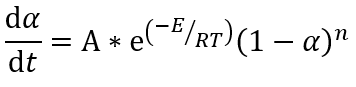
I would like to model rubber curing in Mecway, for a transient thermal step. Basically, I need to calculate da/dt for each step. However, da/dt depends on a:
After that, a could be found using:
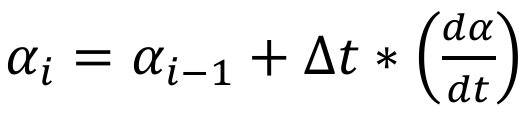
I tried using formulas but got stuck because I can't retrieve values at the last increment. Also, I can't seem to find the time increment (dt) in formulas. Right now, I am exporting temperatures to Excel and computing everything there, that only works a node at a time.
Does anyone have an idea how I could have this in formulas or other to obtain the contour plot of cure (alpha) in Mecway?
Thanks!
I would like to model rubber curing in Mecway, for a transient thermal step. Basically, I need to calculate da/dt for each step. However, da/dt depends on a:
After that, a could be found using:
I tried using formulas but got stuck because I can't retrieve values at the last increment. Also, I can't seem to find the time increment (dt) in formulas. Right now, I am exporting temperatures to Excel and computing everything there, that only works a node at a time.
Does anyone have an idea how I could have this in formulas or other to obtain the contour plot of cure (alpha) in Mecway?
Thanks!
Howdy, Stranger!
It looks like you're new here. If you want to get involved, click one of these buttons!
Comments
However, you should be able to export the Table to Excel and use that to calculate all nodes and all time steps together.
Alternatively, write a Python script with the API which can read values from the solution and write them back.
First equation is an ODE that could be solved exactly once you get the Temperature evolution profile T(t) from the transient. I’m assuming E and R approximately constant.
One side can be integrated previous change of variable for (1-Alpha) but the other side of the equation is node specific as each node has a different Temperature evolution a priori.
Final ODE’s solution constant could be found imposing Curing Alpha =0 at t=0 to get the curing evolution as a function of time for each node. I guess this is what you are now doing.
I don’t think you can solve an ODE from the Formula tool. Even if you solve it outside, it will not have sense to write the formula in MECWAY as it will be node specific.(One Alpha =Alpha(t) equation for each node¿?¿?)
Said that, one simplification could be if the whole part heats uniformly. T=T(t) is not node specific. Kind of a very slow quasistatic heating process. All the body increase the temperature at the same time. In that case, the time integral wouldn’t be node specific.
Not sure if that simplified scenario is of interest.
Regarding the second equation I don’t understand the reason for that linearization of the Alpha curve.
If you can get the exact solution of the ODE ¿why do you want to build the curve with a linear approximation?.
Disla, generally temperature is very unevenly distributed so each node needs its own calculation. The linearization is simple enough and gives precise results, it allows to change the model easily too (just change the equation for da/dt).
Thanks to you both!