Stuck?  support@mecway.com
support@mecway.com

Mecway
FEA
Rubber bellow geometry study

Hi all
I’m new to the software and the forum, so please pardon any basic questions. I’m trying to study a rubber bellows and want to optimize its geometry (radii, angles, fold depth) for a given displacement. The part will be cycled millions of times, so our aim is to find a geometry that maximizes life and avoids crack initiation at the corners.
Since you’re the creators and experienced users of the software, do you think it’s realistic to get useful results — at least a reliable first direction — from it? I can provide all required data; here are the key requirements to start with:
- Min. length: 128 mm
- Max. length: 215 mm
- Stroke: ≈ 80 mm
- Rubber: general, approx. 70 Shore A
I appreciate any tips or recommended workflows. I’ve attached a simplified .stp of the shape and the simulations I’ve run so far.
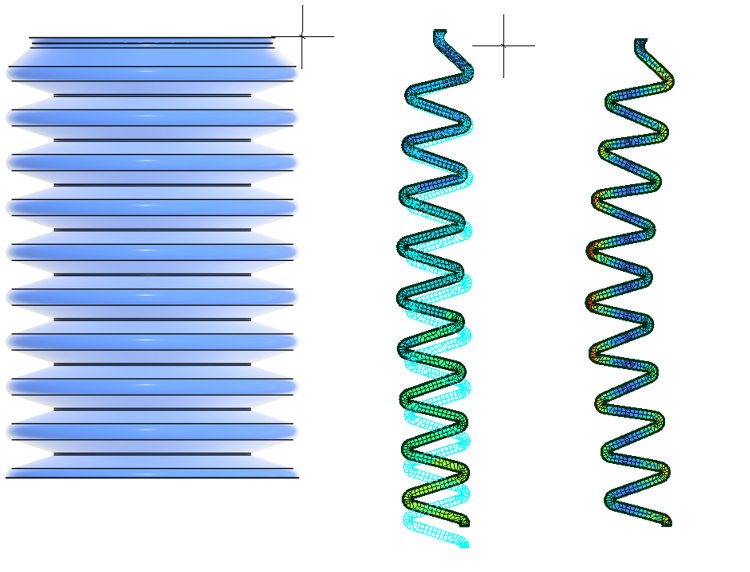
Thanks in advance for your help!.
I’m new to the software and the forum, so please pardon any basic questions. I’m trying to study a rubber bellows and want to optimize its geometry (radii, angles, fold depth) for a given displacement. The part will be cycled millions of times, so our aim is to find a geometry that maximizes life and avoids crack initiation at the corners.
Since you’re the creators and experienced users of the software, do you think it’s realistic to get useful results — at least a reliable first direction — from it? I can provide all required data; here are the key requirements to start with:
- Min. length: 128 mm
- Max. length: 215 mm
- Stroke: ≈ 80 mm
- Rubber: general, approx. 70 Shore A
I appreciate any tips or recommended workflows. I’ve attached a simplified .stp of the shape and the simulations I’ve run so far.
Thanks in advance for your help!.
Howdy, Stranger!
It looks like you're new here. If you want to get involved, click one of these buttons!
Comments
At 80mm stress and strain values are not good for durability :-)
Impressive work — thank you very much for the prompt and helpful reply.
Sergio, it’s remarkable how quickly and competently you handled these topics. Your expertise with the software and in this field really shows. Analyses like this usually take a lot of time, yet you produced solid results in a very short period. Congratulations.
I will contact you separately to continue the discussion.
For the benefit of this thread and out of curiosity for other users, I have a few follow-up questions:
- To further evaluate strength and fatigue of this part, I believe one valuable metric is strain energy density (SED). From theory I recall a rule of thumb to keep it below 2–3 MJ/m³. My question: how can we measure SED in Mecway? Is that possible? In Sergio’s model, is the reported “strain energy density” correct?
- Another parameter to analyze and compare is stretch (λ = 1 + strain). Is it possible to plot the maximum principal stretch in Mecway?
- Finally, a general question: is this overall approach appropriate for this type of study? If you were to optimize the bellows geometry, would you proceed in this way?
Once again, many thanks for all the support — great community and great software!
About durability on rubber, I work for that years ago, we use maximun principal stress (Principal Stress 1 in Mecway), but we have tested our own rubber formulations in durability (in parts and standard samples).
Rubber is a complex material, there are a lot of different compounds, hardness, formulations, process, everything affect durability. Maybe you can make "accurate" predictions for stiffness with coefficients from public papers, but durability will depende a lot of your own specific compound, how it was mixed, and then how was molded, and obviously the geometry of the part.