Stuck?  support@mecway.com
support@mecway.com

Mecway
FEA
Verifying Mecway Results to Ansys Mechanical

Hey
I'm current trying to decide on buying Mecway.
So far I like the intuitive GUI but before I'm going to buy it I want to verify it against ANSYS Mechanical Application test cases https://ansyshelp.ansys.com/public/account/secured?returnurl=/////Views/Secured/corp/v252/en/wb_vm/wbvt-vm-mech-wb.html.
I'm trying to complete VM-WB-MECH-002
Materials
E=1000 Pa
v=0
FEM
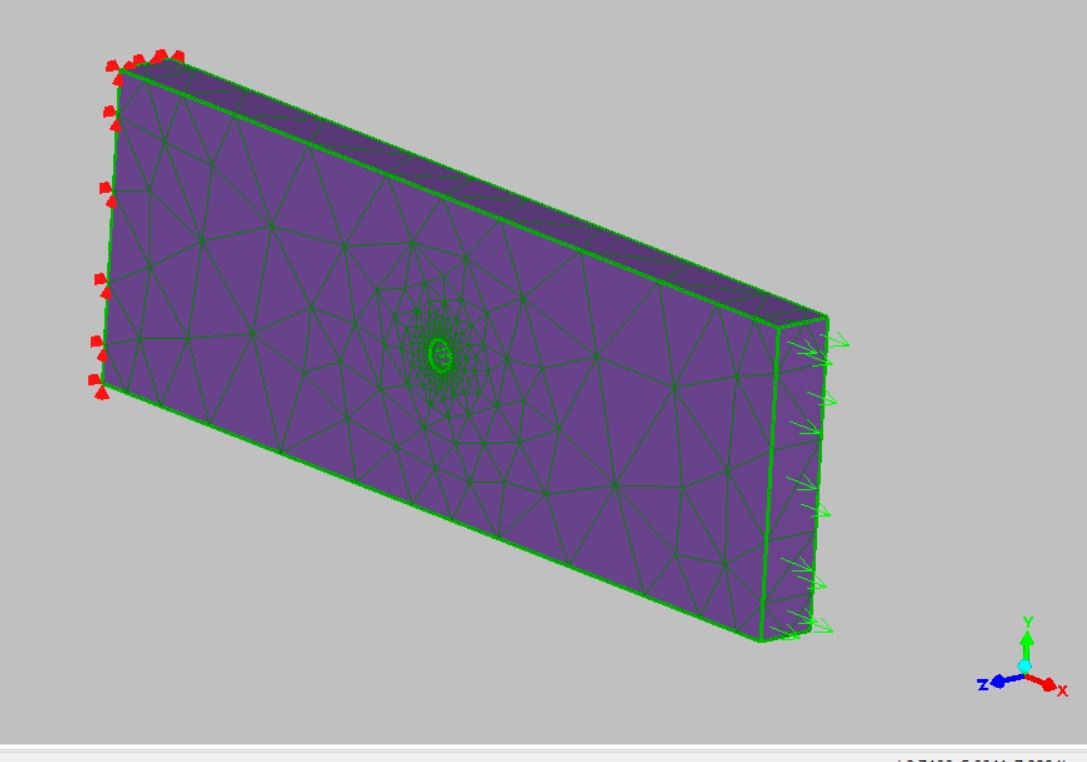
745 Nodes
2601 Elements (Tet4)
8940 DoF
Mesh Size ~1.5m
Mesh Bias ~0.075m Along Hole Edge
Boundry Conditions
Constraints: fixed on side face surface
Software
Pre/post: Mecway
Solver: Internal
Load Case 1
-Opposite face: Pressure of "-100 Pa" in the x direction
Results
Target - Maximum Normal Stress (Pa)-312.5
Mecway - Maximum Normal Stress (Pa)-277 (Element), 250.9(Node)
Error - 12.8%
Synthesis of Results
Due to the limitation of the free version of 1000 Nodes, I have not reached convergence yet.
I am still quite a novice at FEA (only 1-week in), so I may have gotten somethings wrong. I have experienced workmates which is why I'm presenting in this way.
Can someone with a paid version try to verify this test case for me??
Much Appreciated
Cainite
I'm current trying to decide on buying Mecway.
So far I like the intuitive GUI but before I'm going to buy it I want to verify it against ANSYS Mechanical Application test cases https://ansyshelp.ansys.com/public/account/secured?returnurl=/////Views/Secured/corp/v252/en/wb_vm/wbvt-vm-mech-wb.html.
I'm trying to complete VM-WB-MECH-002
Materials
E=1000 Pa
v=0
FEM
745 Nodes
2601 Elements (Tet4)
8940 DoF
Mesh Size ~1.5m
Mesh Bias ~0.075m Along Hole Edge
Boundry Conditions
Constraints: fixed on side face surface
Software
Pre/post: Mecway
Solver: Internal
Load Case 1
-Opposite face: Pressure of "-100 Pa" in the x direction
Results
Target - Maximum Normal Stress (Pa)-312.5
Mecway - Maximum Normal Stress (Pa)-277 (Element), 250.9(Node)
Error - 12.8%
Synthesis of Results
Due to the limitation of the free version of 1000 Nodes, I have not reached convergence yet.
I am still quite a novice at FEA (only 1-week in), so I may have gotten somethings wrong. I have experienced workmates which is why I'm presenting in this way.
Can someone with a paid version try to verify this test case for me??
Much Appreciated
Cainite
Howdy, Stranger!
It looks like you're new here. If you want to get involved, click one of these buttons!
Comments
Highly recommend the purchase. At the basic level, the GUI is so-o-o-o-o much easier than others I've used.
P.S. Incidentally, per Test, your hole radius = 0.5 m, no?
Good pickup on the I skimmed over and thought it said 0.5m diameter not radius
I'm getting 305.5 Pa, Error 2.3%. Now using Tet10.
How did you create such a clean mesh? Did you manually mesh it?
I am starting from Alibre Atom3D part file and creating a idealized version by spliting it in half. I can't find a way to specify hex8 or hex 20 mesh autogen it always force me to use tet10.
Your Test was asking for Max Normal stress (tension in the direction of the load). I see you reported the von Mises stress. Maybe see what you get from the Principal Stress output? Yes, they are close in this case but vM is scalar, derived from up to (9) stress components, and has no directional reference.
Me I was also finding some discrepancy too.
I have look at the source of that problem and solve the equation again.
Arpaci, V. S. (1966). Conduction Heat Transfer. Addison-Wesley Book Series. (p. 130).
Free acces:
https://archive.org/details/conductionheattr0000arpa_k8i6/page/n3/mode/2up
Solution is T=482 ºF not 476 ºF
*MATERIAL,NAME=MATERIAL
*DENSITY
1000
*CONDUCTIVITY,TYPE=ISO
555.1,0
563,4.3
662.4,58
761.9,111.8
861.3,165.6
960.8,219.4
1060.2,273.2
1159.7,326.9
1245.2,373.2
1259.1,380.7
1358.6,434.5
1458,488.3
1557.5,542
1656.9,595.8
1756.4,649.6
1855.8,703.4
1955.3,757.2
2054.7,810.9
*SPECIFIC HEAT
100,0
100,4.3
100,58
100,111.8
100,165.6
100,219.4
100,273.2
100,326.9
100,373.2
100,380.7
100,434.5
100,488.3
100,542
100,595.8
100,649.6
100,703.4
100,757.2
100,810.9
*SOLID SECTION,ELSET=MAIN,MATERIAL=MATERIAL
*INITIAL CONDITIONS,TYPE=TEMPERATURE
TEMPERATURE_NODES(2),373.15
TEMPERATURE_FACES(2),373.15
*PHYSICAL CONSTANTS,ABSOLUTE ZERO=0.,STEFAN BOLTZMANN=5.669E-8
Regards