Stuck?  support@mecway.com
support@mecway.com

Mecway
FEA
How to define the load that is variable along the perimeter

Hi,
What is te fastest way to define load on surface on cylindrical tank but variable along the perimeter ?
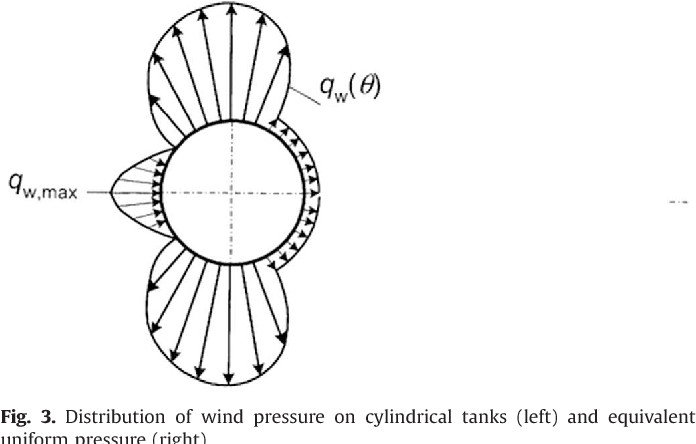
What is te fastest way to define load on surface on cylindrical tank but variable along the perimeter ?
Howdy, Stranger!
It looks like you're new here. If you want to get involved, click one of these buttons!
Comments
I should just type it in pressure loads (normal to the surface) ?
- No variables so you have to explicitly enter the values of d_c and H
- No curly brackets. Use round brackets.
- Dot for decimal point instead of comma
- Only enter the right-hand-side with no equals sign
- Use * for multiplication, not nothing
- Replace θ with atan2(y,x) if that's angle in the x,y plane
For further reference on formulas, click the little "(?)fx" button next to the input.I remember working on this some time ago.
I have rescued some formulas and attach example. If I'm not wrong that profile belongs to EN 1993-4. Anex C
I have substitute dc/H by Pi number for you to easily identify it and also cylindrical stress and strain formulas are included. Base is pinned.
You can extend the formulation with the change in height.
Ccx Pardiso is 4sec to compute.
Disla you are right it's 1993-4, thanks for the example, it helped me a lot